
A health system transforming: Insights from HE Fahad Aljalajel’s opening address at the Global Health Exhibition
The eighth edition of the Global Health Exhibition in Riyadh, Saudi Arabia, offered a compelling vision for the future of healthcare. In the opening address, Saudi Arabia’s Minister of Health, HE Fahad Aljalajel, set the tone for the event, emphasizing the Kingdom’s commitment to redefining healthcare as a cornerstone of national progress.
The Minister’s address highlighted not only the scale of ambition but also the strategic shift underway in healthcare — from reactive care to proactive, preventive health management. This transformation is not just a response to challenges but a proactive effort to build a resilient, innovative, and sustainable health system for the future.
Evolving health systems to meet global needs
- The growing burden of chronic diseases: Chronic illnesses now account for the majority of global deaths, requiring a shift in focus toward prevention and management.
- Rising healthcare costs: As expenditures climb, health systems are seeking ways to deliver better outcomes while ensuring long-term sustainability.
- Expanding mental health needs: Mental health is increasingly recognized as a critical component of overall well-being, necessitating integrated care approaches.
- Workforce challenges: Addressing workforce shortages is essential to maintaining effective and equitable healthcare delivery.
These dynamics are not obstacles but opportunities to reimagine healthcare systems that are more efficient, inclusive, and patient-centered.
From reactive to preventive care: A vision for the future
Saudi Arabia’s approach to prevention is both innovative and comprehensive. Initiatives such as premarital screening, expanded genetic counseling, and national newborn screening programs demonstrate how upstream interventions can be scaled to create a healthier population.
This focus on prevention is not just a healthcare strategy; it is an economic and societal imperative. By addressing health challenges early, the Kingdom is reducing long-term costs, improving quality of life, and ensuring the sustainability of its health system.
Transforming healthcare through measurable progress
- Early cancer detection: Nearly 70% of cancer cases are now detected early, improving survival rates and reducing treatment costs.
- Chronic disease management: Mortality linked to chronic diseases has declined by 40%, exceeding global targets.
- Road safety improvements: Road traffic fatalities have been reduced by more than 60%, surpassing international benchmarks.
- Increased life expectancy: Life expectancy in Saudi Arabia now exceeds 79 years, reflecting the success of holistic health initiatives.
These achievements demonstrate the power of a data-driven, outcome-focused approach to healthcare reform.
AI in Healthcare: A New Era of Integration
The Minister announced that Humain and Lean have received approval from the Saudi Food and Drug Authority (SFDA) to begin a clinical trial of an AI-powered “doctor.” This groundbreaking initiative is described as one of the first clinical studies of its kind globally. It signifies a shift from testing AI in controlled lab environments to evaluating its performance in regulated clinical settings. The trial aims to explore the best ways to integrate advanced AI into disease diagnosis, provide direct care guidance, and ensure accuracy and safe deployment. This milestone reflects Saudi Arabia’s regulatory readiness, growing confidence in AI-driven diagnostics, and a transition from experimental applications to real-world clinical validation. Globally, where most AI tools remain assistive, this approval suggests a bold step toward frontline integration.
In addition, the Minister announced the launch of an AI-powered Smart Health Coach in partnership with Google. This innovative tool will be integrated into the Sehhaty app, providing personalized health guidance to individuals. This marks a significant shift in AI’s role in healthcare, moving beyond diagnostics to focus on preventative, personalized, and daily health support. The Smart Health Coach represents a new era of intelligent personal care, where technology becomes an integral part of individual health management, serving as a preventive health companion and a digital guide embedded within the national health infrastructure.
These developments underscore Saudi Arabia’s commitment to not only adopting AI but also regulating, clinically validating, localizing, and integrating it into its national health platforms. Through public-private partnerships, global technology collaborations, and national regulatory approvals, the country is advancing toward a future of AI-assisted diagnostics, personalized care at scale, and preventative digital health models. AI is no longer a futuristic concept; it is rapidly becoming a cornerstone of modern healthcare, driving a transformation toward continuous, patient-centric care. These groundbreaking innovations are not only improving efficiency but also empowering individuals to take greater control of their health and well-being.
Building resilient healthcare ecosystems
The Minister announced that Saudi Pharmaceutical Investments Company (Lifera) is working to localize the manufacturing of several vaccines in collaboration with global leaders such as Sanofi, Merck, and Pfizer. This initiative represents a significant step in strengthening domestic production capacity, ensuring the Kingdom’s ability to meet its healthcare needs independently while contributing to global health security.
Additionally, the Kingdom’s advancements in biotechnology were highlighted, including King Faisal Specialist Hospital’s success in producing fully localized T-cells to treat certain types of cancer. This achievement positions Saudi Arabia as a regional leader in advanced healthcare and demonstrates its potential to become a global destination for cutting-edge medical innovation.
By fostering innovation, enhancing research capabilities, and building robust supply chains, Saudi Arabia is creating a healthcare ecosystem that is not only resilient but also interconnected with global health priorities. This approach underscores the critical role of supply chains, research, and workforce development in ensuring healthcare sustainability and resilience, where clinical care is supported by a strong foundation of localized production and innovation.
A People-Centered Approach to Transformation
As we chart the course for the future, this human-centered approach must remain the guiding principle. Every decision must prioritize the dignity, health, and well-being of individuals, ensuring that healthcare systems are not only innovative and sustainable but also deeply compassionate, inclusive, and equitable. It is this commitment to humanity that will define the success of healthcare transformation in the years to come.
Conclusion
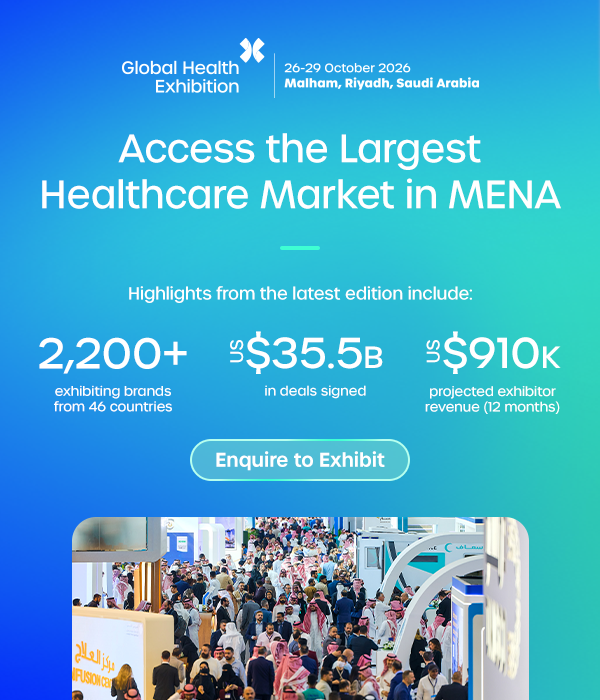
Be part of this unparalleled event and join the discussions that are shaping the future of global healthcare. Register your interest for the Global Health Exhibition 2026 today: https://globalhealthexpo.info/li-social


Foundation Partner

Foundation Partner

Platinum Partner

Silver Partner

Silver Partner

Silver Partner

Media Partners
















.png)





























.png)